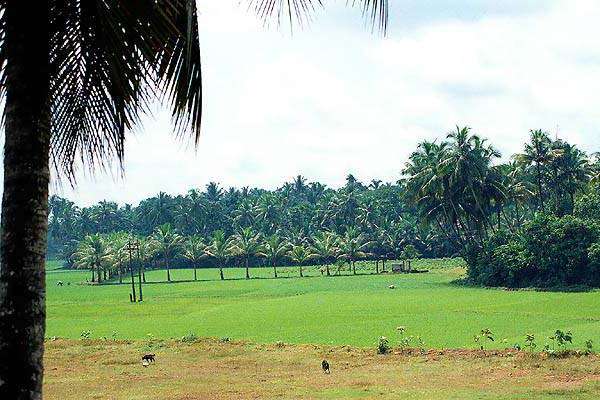
EZHOME (moola), located near payangadi of Kannur Dist. The village covers an area of 20Sq KM. According to the 1991 census
it had a population of 18,555 of which 9433 were females and 9122 males.
It is said that about a hundred years ago, three traditional aristocratic
families were owned the entire land of Ezhome Village.
The chirakal Kovilakom,a Royal family and two Namboothiri families,
Mootheadthu Illom and Eleadethu Illom.
These families did not directly cultivate their lands but leased them out to a large number of Local Farmers. The rent used to be fixed on the basis of the quantity of paddy used as Seed during a crop period. Three people, Chappan Muhammed, Moovakkan Hassan and Palangaden Kelu Nambiar and later their Successors Kallayi Valappil Moovakkan Moideen Kutty,Kallayi Valappil Moovakkan Kunhi Abdulla etc., They leased out, in turn some of their leased-in/sold land to small cultivators.
KAIPAD - PADDY CULTIVATION
The Kaipad fields are low lying and immersed in water they have to be dried before starting cultivation. The tidal flows have to be controlled to prevent from water entering the fields, for this purpose
bunds have been constructed at the narrow ridges of Kaipad fieldes near the river. The bunds are madeup of sticky mud collected from the river banks and wild grass. On an average, the bunds are about 10 feet broad with highest a little over the water level at the time of high tides. Locally the bunds are knows as Chira or Kandi. The flow of water is rugulated by a sluice woden gate, locally known as Mancha.
the agricultural operations begins by middile of April. The saline water is drained out completely and fields are dried, small mud (potta) are formed by male workers. This operations will be over by the middle of May. The farmers then wait for mansoon rains, by June the mansoon arrives and it strengthens the salinity of the soil in the mounds is washed down by rain water. As soon as there is adequate fresh water flow in the river, the water outlets of the bunds are opened. From this time onwards tidal flows are not controlled all through the entire crop season. "The fresh river water tides wash down the salinity of the soil. Before sowing farmers soak the seeds in water for 24 hrs and leave the wet seeds three days in bags locally known as 'Chaak' to germinate. The germinated seeds a varity known as 'Kuthir Vitthu' as bown on the mounds. after one and half months of groth the saedlings become mature enough for transplantation.The seedlings in the mounds are dug out together with the root soil by male workers and are planted uniformly by women workers inthe field after removing the weeds. The transplanting work will be over by Junly Aug in this method of cultivation neither organic nor chemical fertilisers are used and is practised with no change even to date. The harvest depends on the intensity and rate of rainfall. If there is heavey rainfall or lack of rain there will be crop failure. If the rainfall is low saline water will enter the field during tides and destory the crop. The crop is usually harvested end of Sept and Middle of October.
KANDY KALAKKAL
The kaipad fields become common access property on Vishu chankrnthi day (mostly on April 14th)., from this day onwards any one can catch fish from these private paddy fields untill June. Usually the bund owners and or the leased in fish harvesters undertake intensive fishing before opening the area to the public. To maximise the harvest two or three days prior to Kandy kalakkal the owners allows any body with any traditional methods to fish in the fields, on condition that half the cached fish shall be given to him/them. this practice is reffered as Kandy kalakkal.
TAPPAL
Agricultural women workers who have some traditional methods/skills to trap prawns (chemeen) by using hands (without using any equipments) locally known as 'Tappal'. Umbry & Kancharady (Swami Narayani) are known as experts in this field.
CHEMEEN PANAM
The panchayat began leasing out for prawn filtration every year by giving the 40% share of chemeen panam to the land holders in the bund and utilising 20 percent for maintenance of bund and retaining 40 percent due to the bund owner.
[Grateful to C.P. Hassan, Shanmughan Palakeel, C.P. Sara Kutty & K.V. Abdul Kader for sharing their knowledge and experience in kaipad cultivation/kanddy kalakkal)
/Created 1999/UAE